Sunday, July 20, 2008

Amazonas Trip - Day 3 - Afternoon to Finish

As I mentioned in an earlier blog entry the resort was like from out of a Hollywood set. Constructed in timber and bamboo it blended nicely with the surrounding jungle.

(Left - my bedroom with the mosquito netting rolled up on my bed)

Rooms had only 3 walls giving a outlook to the nearby jungle. Rooms also had no doors, but hanging curtains. Naturally all beds were fitted with mosquito netting, and we also had brought anti malaria tablets - just in case.

(Right - another view of the bedroom looking to the main entrance. Curtains to the left are to the bathroom)


(Left - rooms were equipped with hammocks for that siesta time)


(Right - on a stroll by myself along the jungle tracks I found this colorful butterfly - called "mariposa" in Spanish)

(Left - I walked to this outlook overlooking the Tambopata river where I could watch the passing parade)

(Right - overhead the birds wheeled)


(Left - a very large catterpillar on the path)


(Left - spot the frog in the picture?)


(Right - the dining room on the lower level - we sat with our guides for each meal which was a buffet - not a huge range of foods, but satisfying)


(Left - our riverboat waits for the final trip back to Peurto Mondonaldo


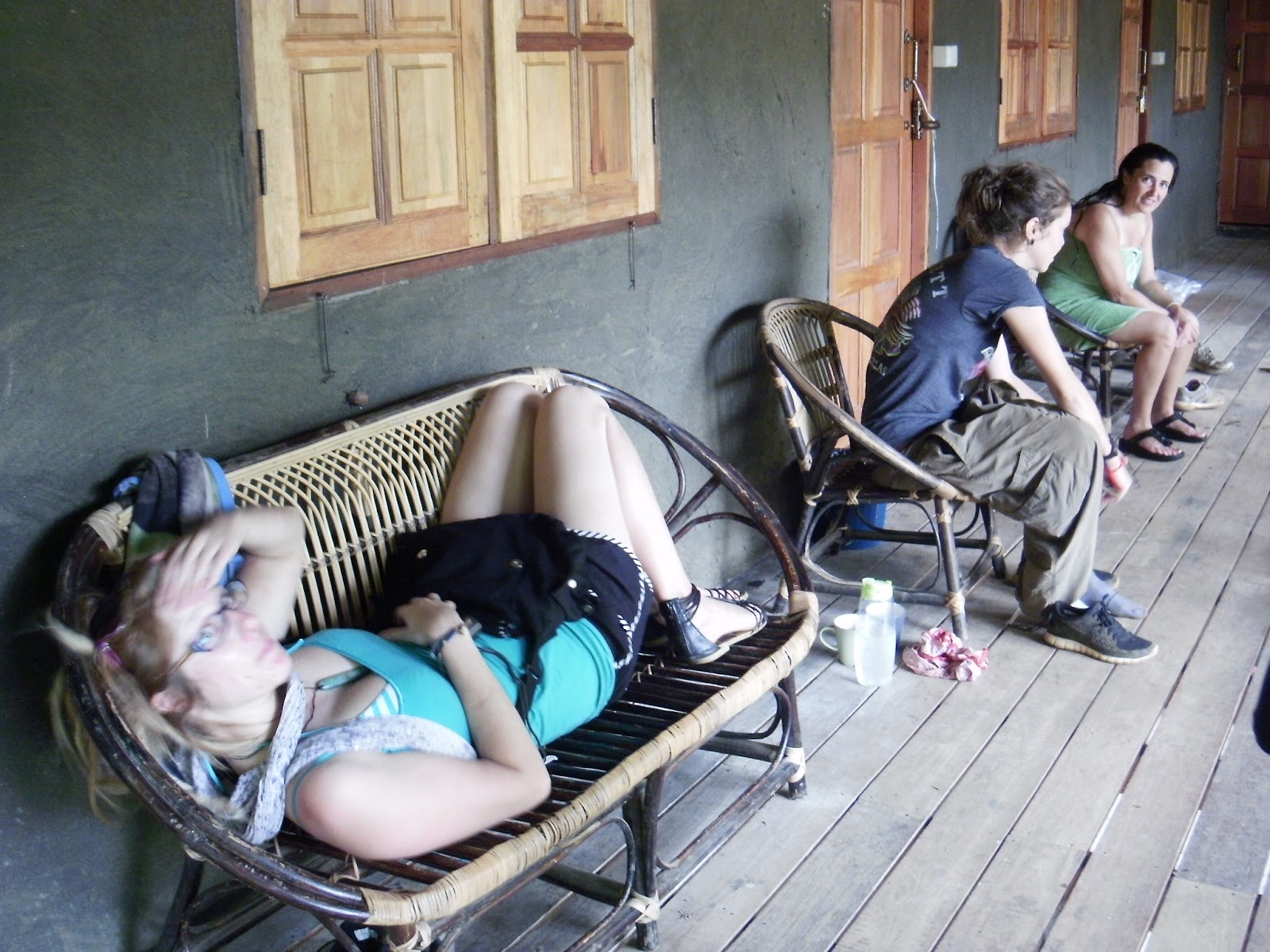
(Right - it was a quicker trip back as we were now with the current, but still around 3 hours - so for some it was a good time to doze)


(Left - a bit difficult to see, but a flock of birds were squawking in the tree - our boat stopped for a look)


(Right - and back at the airport we were ready for our 45 min flight back to Cusco)


Saturday, July 19, 2008

Amazonas Trip - Day 3 - Morning

Fortunately there was an option of paying money to stay an extra day, which we availed ourselves of - US$100, which turned out to be good value we thought. Especially as travel to and from the lodge takes the nest part of the first day, and timing requires early morning departure on leaving on the last day.

(Left - another group boards their boat for the trip down river back to Peurto Maldonada for their trip back to civilasation - note the gentle picking of the way over the mud)

(Right - our hotel name plate hanging outside the front entrace)

We seemed to do more on the first day, and on the second day in the afternoon, our venture to see the clay lick of the wild pigs was pretty well non-eventful, so this blog covers some general bits and the morning of the third day.

(Left - the gumboots lined up outside the front entrance for those tracks used early in the morning after all the evening precipitation - after all it IS a rainforest)


(Right - a stand outside is used to demonstrate opening of local brazil nuts - with a large machete, and also an even larger strong arm. Once opened the outer pod shows some 10 - 12 brazil nuts still encased in another very hard shell. These are cracked open with a special nut cracker. In the early morning a squirrel checks to see if there are any left over pieces of brazil nut for breakfast)


(Left - we make the usual hazardous crossing to the boat on the river)

(Right - we cruised along the river to our next feature point)


(Left - one of the fee animals that we saw was a Pacybara, a bit like a big wombat but with much stubbier nose. These are river bank creatures, who love the mud - it helps with insect control)

(Right - this particular animal also had a sore on its back, generally where the insects lay their eggs. Some of the local birds work with the Pacybara and sit on its back feeding off the insect larvae)


(Left - at the end of our short ride we alighted - again on the riverbank - VERY carefully)

(Right - and headed off into the jungle again)


(Left - Along the jungle track for about an hour)


(Right - this tree was covered with caterpillars, each of which can give a painful sting)


(Left - this tree is covered with very strong and sharp needles. Originally local natives would break off these needles, dip the points into the poison sack on the back of some of their local frogs, and use them for poison darts in blow guns)

(Right - our guide Paty demonstrates the use of the umbrella palm for inclement weather)


(Left - this cone is the home of the local cicada. It builds this mud cone for depositing its eggs. Inside there can be several layers as the cone is used again)

(Right - our intrepid explorer on the track)


(Left - as you may imagine there is a constant battle for sunlight from above. This tree with the long roots is known as the "walking tree". It sends down its roots on the side which is believes will give it more sunlight, and sheds those on the duller side. In this way it can "move" up to 5cms a year toward an area where there is more access to light.)

(Right - we continued onward through the jungle)


(Left - it would be quite a battle without paths)


(Right - these palm leaves fall to the ground, and generally land this way up. Hence they can catch the moisture and provide a place for small frogs to lay their eggs)


(Left we finally reached our objective - a bird hide constructed overlooking the clay lick.)


(Right - at this strech of the river the banks contain an element of clay which the birds use to digest. This clay helps offset the toxins which the birds may have absorbed in their daily seed eating)


(Left - unfortunately we didn't see too many birds - we heard a lot - but if the birds had come this is what they would have seen - me on the right)

(Right - after our non-bird spotting we walked back to the river bank, and waited patiently for our boat. Times in Peru are very slack - anything up to a half hour is "on time". So we amuised ourselves watching this group of butterflies on the river bank.)


(Left - finally our boat arrived to meet us - our guide Paty on the banks)


Wednesday, July 16, 2008

Amazonas Trip - Day 2

Day 2 started early - in fact at 5am, when our personal guide, Paty, knocked on our doors - well on the door frame, as we didn't have any doors. She had asked us to acknowledge so that she knew that we were awake. I was already up anyway, as I didn't want to miss out on anything.
(Left - the lookout tower)

We assembled in the main foyer, traded our boots for the hotel supplied gumboots - try finding two gumboots of the same size!- and then we set off with torches along one of the jungle paths to the lookout point.
(Right - the sun comes up on another day in the jungle)
The lookout point was some 20 min walk from the main building, and is a 30 metre steel tower set in a small clearing in the jungle. This height takes it above most of the surrounding treel line. We climbed to the top, and waited for the sunrise. (I did note that the tower is braced with about 8-10 sets of cables on each side.) Once at the top, the guide cloesd the trapdoor through which we had just climbed. There were 10 of us including the guide, and that was quite jammed.
(Left - we headed off along another jungle path back to the river, where our ferry man was waiting)
After about an hour we headed back to the lodge for breakfast, and then our next venture starting at 9.30am

(Right - Erin and Courtney start to negotiate the tricky part of boarding)
The main problem with all this boat travel was the poor facilities to enable one to get onto the boats. There are no jetties, and boarding requires negotiating the slippery boarding plank (actually the bottom of some departed boat!!), then steeping onto the small ramp that lead up to the boat. This was generally canted at and angle, and the mud on the bottom of ones shoes made it quite hazardous)

(Left - our guide, Paty, explains with a dust drawing about farming in the area. The local people gain a piece of land, and then clear one quarter for planting. The following year the first plot lies fallow, and a second quarter is cleared for further crops)

(Right - bananas are one of the big crops in the area. The farmer sells to the river taxis, that buy the produce and carry it down river to the markets. Naturally the farmer gets a pittance of what the end man gets)


(Left - Paty shows us another of the fruits grown here. Once peeled the flesh inside is very soft and tastes a bit like custard apple)

(Right - whilst at the farm a passing butterfly takes a little rest on Courtney's shoe)


(Left - meanwhile back at the lodge lunch is being served - buffet style - simple but sufficient - and when you consider there ius no electric power for lighting - they do make an exception each day from 12 - 1 and 5.30 - 9.30 when they have some power generation for those of us who need to recharge camera or phone batteries)

(Right - after lunch, and a siesta, we were off again, on another walk to a nearby lake where we boarded a small canoe. My biggest concern was that with five of us on board there was some 4 inches free board, which made me quite nervous. In addition whilst we were made to wear life jackets on the river trip up, there was no compulsion here)

(Left - on the lake we saw a number of small bats clinging to a partly submerged loog)

(Right - we left the boats and walked into the jungle on the other side. Paty showed us some large trees, which hold religious sugnificane to the local people. This is a large white kapok tree which the Shamuns visit regularly, as it is said to contain good spirits. The Shamuns also visit a nearby red kapok tree - these latter contain the bad spirits - but you have to keep the bad spirits on nside too.)

(Left - for good measure Erin and Courtney stand inside the roors of another very large tree.

(Right - some of the trees in this area are very big)


(Left - after our tree viewing we returned to the boat, and I held my breath as we steadily made our way bacj across the lake to the original side)


(Right - we were however treated to a lovely sunset)


Monday, July 14, 2008

Amazonas Trip - Day 1

For all volunteers who come to Peru's Challenge there are a number of included tours. As your stay is longer so are there more tours included.

(Left - coaches took us from the airport to the river bank of the Tambopata river)

Those coming for 12 weeks get the added tour entitled "Amazon Jungle", and so this was to be my last tour whilst I was here. I was fortunate in taht another 12 weeker, Erin, and also Courtney, an employee of Ultimate Tours who was doing familiarisation tours wanted to go at the same time. So there were three of us, which makes for more enjoyment in travelling with friends.

(Right - all supplies for the area go up on the river boats)

The title is a little misleading in that the tour goes to the Tambopata river, which is a far distant source of the Amazon, and the area is more correctly entitled Amazones - it is a part of the Amazon jungle, but well removed.

(Left - we walked down a very steep stairway to reach our boats)

Still it IS jungle, and one has to travel by launch some 3-4 hours up the Tambopata river to reach the accommodation. In addition it is well removed from civilisation.

(Right - we board our vessels for the 3-4 hour trip up river)

(Left - one of the requirements is to wear life jackets for the journey - Courtney and Erin don theirs)


(Right - there were two vessels in our group that day. This one set off just behind us.)


(Keft - lunch was served as soon as we left. Thus was a combination of Chinese and Peruvian - being a rice base with local flavours mixed in. The lunch was served in a banana-like leaf, and was useful to dispose of - just put over the side as it is bio-degradable!!)


(Left - upon arrival at the destination we still weren't there - we still had about a 10 minute walk through the jungle to reach our accommodation at Refugio Amazonas)

(Right - our trusty vessel with its ramp over the edge to "assist" passengers alighting - hopefully it would keep at an angle that permitted you to mstep onto the next board, and not into the mud!!))


(Right - we emerged from the jungle to find our retreat - almost like a scene out of a Hollywood movie)

(Left - the rooms were reached by an elevated walkway)


(Left - bedrooms were quite well fitted out - however, one slight difficulty at the onset, was that the rooms had no doors - just curtains - and also the wall closest to the jungle was missing. So you had a very nice view out onto the neighbouring jungle - but there was no walkway, so your privacy was undisturbed)

(Right - the view along the elevated walkway back to the main building)
(Left and Right - one thing all jungles have in common is mosquitos, and the danger of malaria. This was no different, and all beds were equipped with mosquito netting.)


New Kindergarten - Yet More Painting

As you can see the building painting is progressing nicely.

(Left - the building takes on its final colours)

Blue is the main colour - light sky blue for the upper areas, and dark blue down lower where it will suffer harder wear.

Now the next step is to highlight the windows - and what better colour than bright yellow - the brightness of the sun. After all the Incas worshipped the sun.

(Right - volunteer Claes adds the brighter touch. Selvey can just be seen inside.)

(Left - the door and windows are outlined in darker blue)


Sunday, July 6, 2008

New Kindergarten - Concrete Mixing

Concreting is a tedious job , when done by hand.
(Right - Jesus pours the cement into the barrel)
(Left - Jesus pours the concrete onto the tipped wheel barrow)
Our builders are used to doing it this way, but to improve matters PC acquired an electric powered cement mixer to speed the task.
And for the men it was like a Christmas present.
(Right - add the sand)
(The only reservation that I had was their method of connecting the electricity!! Safety is not higth on the agenda here. Electric power is 220 volts and there are NO earth connections - everything is 2 pin!! And at work here they took the power leads - no connecting plugs and wound the bare wires around the one running from the cement mixer!!! But it seemed to work, and no one sufrfrered - at that stage!!)
(Left - our new mixer)

The other slight problem was that when the cement mixer was tipped to pour the slurry the barrel was that low to the ground the receiving wheel barrow had to be tipped on it's side to receive it. Then with the angle of the wheel barrow some of the cement spilled onto the ground. Still it did help the speed of the work, and the workers loved it.
(Right - another load of freshly poured concrete is on its way)


(Left - inside the workmen are packing the poured concrete around the foundation stones)

(Right - the pourer returns for another barrow load of concrete)


(Left - another load arrives and is tipped onto the foundation stones)

(Right - the concrete pour continues)


New Kindergarten - The Paths

Concreting is an interesting aspect of the local construction work.


(Left - the formwork in place ready for the stones to be layed)

There is no usage of our traditional steel reinforcing mesh or rods. Instead they use a foundation of large rocks. These are broken up to provide a firm base. In addition the rocks are broken and layed in such a way that there is a reasonably level surface to the top. These rocks are placed such that they are quite stable.


(Right - the full footpath with form work edging is prepared, ready for the addition of more stone which is to have the upper surface levelled.)

The top surface is even checked for levels by string lines.

When all is ready the concrete is mixed and poured over the stones, then smoothed in the normal manner.

(Left - the kitchen floor has been layed and coloured over a base of levelled stone)


(Right - the finished path with stones ready for the concrete to be poured. Note the level achieved on top.)